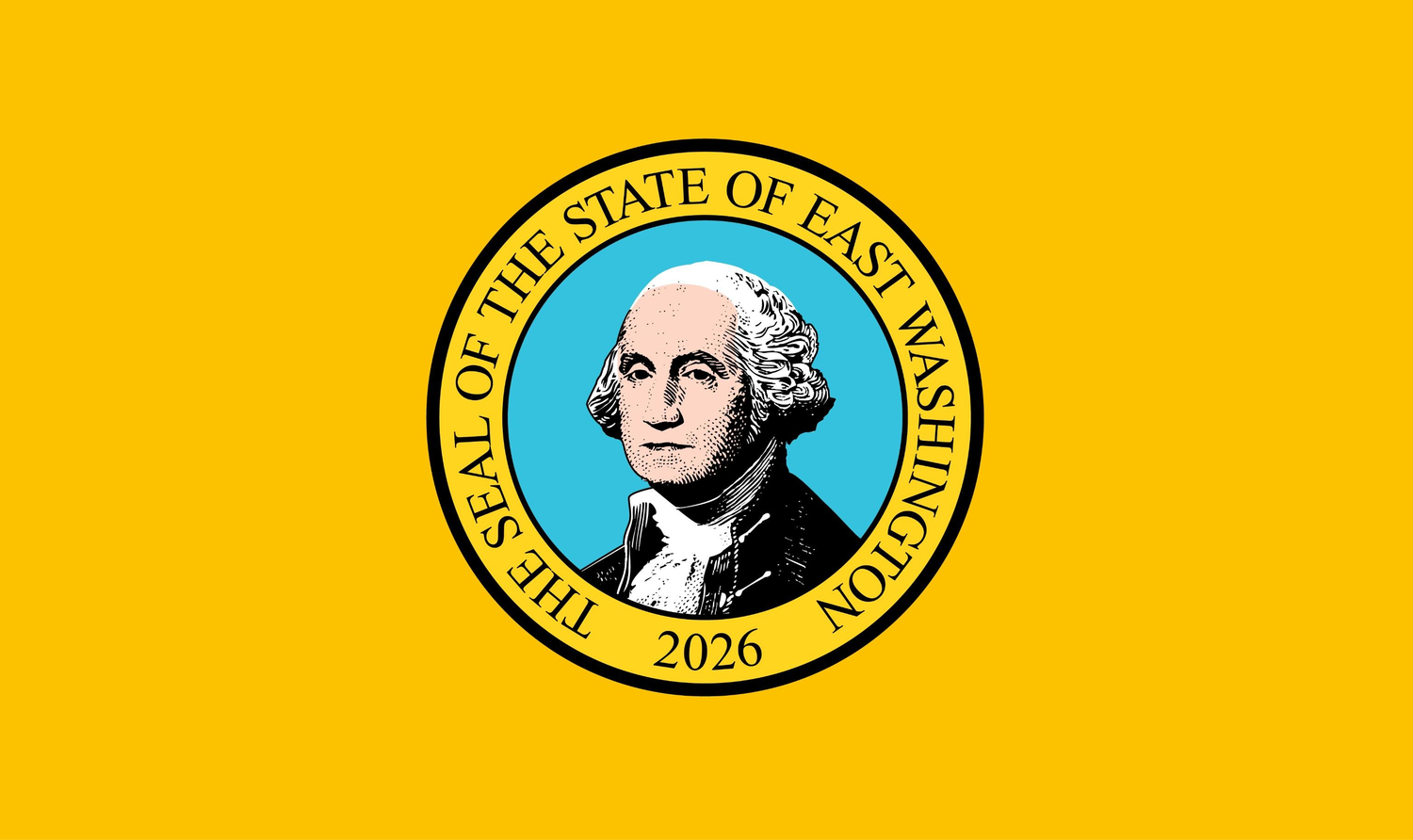
The East Washington Statehood Commission
A non-partisan civic body advancing one question for the people of East Washington, through the constitutional process established by Article IV, Section 3 of the United States Constitution.
The Question Before the People
"Do the people of the twenty counties east of the Cascades wish to form the State of East Washington?"
A procedural body. One question. One outcome.
The East Washington Statehood Commission ("the Commission") is a non-partisan civic body organized as a 501(c)(4) social welfare organization under the laws of the State of Washington. The Commission was established to advance, through the constitutional process, a single question for the people of East Washington: whether they wish to form a new state of the Union.
The Commission takes no position on any matter of policy. The Commission endorses no candidate, no party, and no ideology. The Commission's scope is procedural and constitutional only: to ask the question, and, should the people of East Washington answer affirmatively, to follow the path established by the United States Constitution and by historical precedent.
What is "East Washington"?
East Washington refers to the twenty counties of the State of Washington that lie east of the Cascade Mountains, comprising approximately 1.7 million residents and a regional economy of approximately $90 billion in annual gross domestic product.
- Adams
- Asotin
- Benton
- Chelan
- Columbia
- Douglas
- Ferry
- Franklin
- Garfield
- Grant
- Kittitas
- Klickitat
- Lincoln
- Okanogan
- Pend Oreille
- Spokane
- Stevens
- Walla Walla
- Whitman
- Yakima
How a state is formed.
Article IV, Section 3 of the United States Constitution provides that a new state may be admitted to the Union from territory within an existing state with the consent of the legislature of the state concerned and of the Congress of the United States. The Commission's work follows that path, in order, in public, and at the pace of the people.
-
Civic engagement
The Commission works publicly to ensure that the people of East Washington are informed of the question and of the constitutional process by which it would be resolved.
-
County-level support
County commissioners across the twenty counties consider resolutions in support of placing the question before the people.
-
Constitutional convention
A convention of delegates is convened to draft a proposed constitution for the State of East Washington.
-
Enabling Act & Congressional consent
The Washington State Legislature and the Congress of the United States consider the enabling legislation contemplated by Article IV, Section 3.
-
Referendum
The people of East Washington vote on the proposed constitution and on the question of statehood.
-
Admission to the Union
Upon ratification and Congressional admission, East Washington takes its place as the 51st state of the United States.
Historical precedent
The most direct precedent is the admission of West Virginia in 1863, formed from territory previously within the State of Virginia. The constitutional questions raised by that admission were settled by the Supreme Court of the United States in Virginia v. West Virginia, 78 U.S. 39 (1871).
The Commission also draws on the modern precedent of the Hawaii Statehood Commission (established 1947) and the Alaska Statehood Committee (established 1949), each of which advanced its territory's question through extended civic effort prior to admission in 1959.
Answers to the questions we are asked most.
What is the Commission's position on [taxes / firearms / abortion / education / immigration / healthcare / the environment / any other policy matter]?
The Commission takes no position on any matter of policy. We look forward to seeing what the people of East Washington do via the legislative process.
Policy decisions belong to a future legislature elected by the voters of the future state. The Commission's scope is one procedural question only.
Is the Commission a Republican effort? A Democratic effort?
The Commission is a non-partisan civic body. It endorses no candidates, supports no campaigns, and is affiliated with no political party. Its scope is one procedural question, whether to place the question of statehood before the voters of East Washington, and nothing more.
Why is the Commission doing this?
Article IV, Section 3 of the United States Constitution provides a process by which a new state may be admitted to the Union. The Commission exists to ensure that the people of East Washington have the opportunity to consider the question of statehood through that constitutional process.
Has a state ever been formed this way before?
Yes. West Virginia was admitted to the Union in 1863 from territory previously within the State of Virginia. The constitutional questions raised by that admission were resolved by the Supreme Court of the United States in Virginia v. West Virginia, 78 U.S. 39 (1871). Hawaii and Alaska, the most recent additions to the Union, were each admitted in 1959 following extended civic efforts of the kind the Commission models itself on.
What happens to West Washington?
The Commission's scope is a single question put to the people of East Washington. The Commission takes no position on the future of any other state, region, or political body.
Is this secession from the United States?
No. Statehood is the opposite of secession. The question is whether East Washington should become the 51st state of the United States, a fully equal member of the Union.
How is the Commission funded?
The Commission is organized as a 501(c)(4) social welfare organization. Funding comes from individual donors who support the question being asked. The Commission accepts no funds conditioned on a position on policy, no funds from candidates or campaigns, and no funds from any source the acceptance of which would be inconsistent with its non-partisan posture.
Will statehood raise taxes?
The Commission takes no position on taxation. Taxation in a future state of East Washington would be determined by the legislature elected by its voters, under a constitution drafted in convention and ratified by the people. We look forward to seeing what the people of East Washington do via the legislative process.
Can East Washington afford to be a state?
The twenty counties contain approximately 1.7 million residents and a regional economy of approximately $90 billion in annual gross domestic product, comparable to several existing states. The Commission will continue to publish factual analysis of the fiscal questions involved. Final decisions on budget, taxation, and structure are matters for a future constitutional convention and a future legislature.
How can I help?
The Commission's work moves at the pace of public engagement. Subscribe to receive updates, share the question with your neighbors, and engage with your county commissioners on whether the question should be placed before the people.
Is the Commission affiliated with any candidate, campaign, or party?
No. The Commission endorses no candidates, supports no campaigns, and is affiliated with no political party.
Civic engagement is how the question advances.
To receive updates from the Commission, please contact us at the address below. The Commission will publish a public mailing list signup as the necessary infrastructure is established.
Public materials.
The Commission publishes its analysis, presentations, and reference materials for public review.
- Public presentation: Understanding the Opportunities and Challenges of Statehood for East Washington (available upon request).
- Article IV, Section 3 of the United States Constitution.
- Virginia v. West Virginia, 78 U.S. 39 (1871).
- Washington State Legislature, Resolution 4607 (historical reference).